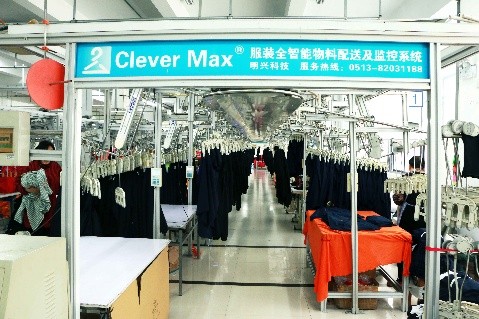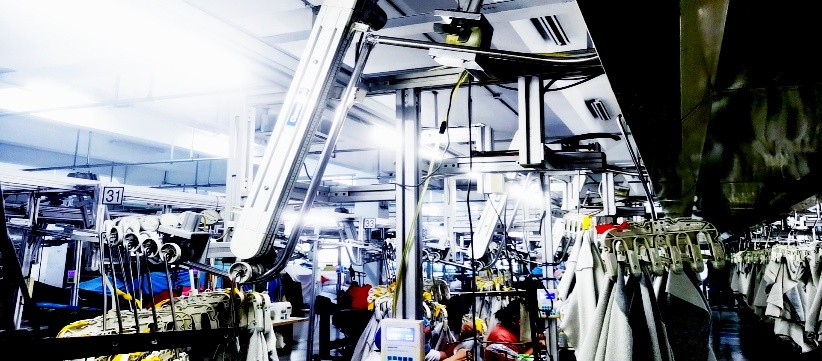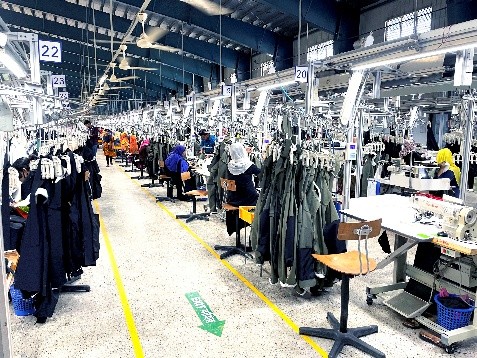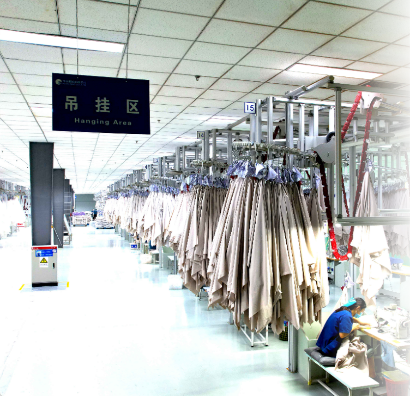
Intelligent Overall Solution for the Apparel Industry
Apparel Manufacturing Industry Pain Points & HANGER SYSTEM Solutions
Small batch production, rapid product turnover, and high conversion costs.
Flexible production lines can meet the practical business requirements of small batches and mixed production of multiple varieties simultaneously.
Real-time data is not readily available, affecting timely production adjustment decisions.
All software, hardware, and equipment data across different regions within the group are seamlessly integrated, centralized, standardized, analyzed, processed, and used for instructions.
On-site management and employee evaluations are disputed due to the lack of data support for fairness.
Tracking, piece-rate measurement, efficiency analysis, quality analysis, individual skill levels, comprehensive skill levels, and skill development curves provide multidimensional, real-time feedback on various aspects of workforce performance, productivity trends, operational efficiency, and continuous improvement potential.
Employee work efficiency is relatively low, making it challenging to improve efficiency through traditional means.
functional operations, ensuring transparent performance tracking, precise cost accounting, and real-time production visibility across the entire workflow.
Relying on increasing manpower to boost production capacity, with a relatively low level of automation, it’s challenging to Flexibly choose to implement overall or partial smart upgrades.
Flexibly choose to implement overall or partial smart upgrades. Tailor the level of automation and informatization to specific needs by combining or splitting software and hardware components.
Some products have short lead times, making it difficult to dynamically expand production capacity.
For orders with tight delivery schedules, rush orders can be accommodated at any time. The production line seamlessly switches between different product types. Fabric pieces on the intelligent hanging system are automatically identified, tracked, and routed to the appropriate workstations, ensuring flexible scheduling, minimal changeover time, and uninterrupted production flow.
Payroll calculations (hourly and piece-rate) consume a significant amount of labor costs.
S. Real-time collection of individual production data and quality data, automatic generation of daily wage reports for hourly and piece-rate workers.
Difficulty in recruiting workers and high labor costs are the main obstacles to business development.
By employing various intelligent methods, we optimize handling, scheduling, management, and statistical processes, reducing the need for human resources, improving workforce efficiency, and enhancing overall operational transparency, cost control, and production stability.
Difficulty in controlling outsourced data.
Integration of data from various factories (including satellite factories) through the Industrial Internet platform to obtain real-time information on internal and external scheduling of all orders.
Managing multiple orders with various styles, sizes, and delivery dates, and matching them with multiple production.
Through multi-dimensional comprehensive analysis combined with delivery deadlines, intelligent man-machine optimization recommendations are provided to address pain points in GST operations, improving production balance, shortening lead times, reducing bottlenecks, and ensuring stable, high-efficiency manufacturing performance.